The 2025 reality check
EV adoption is accelerating, led by a handful of states that account for the bulk of sales, but infrastructure and affordability are uneven across India. That makes CNG a practical bridge for mass urban transport and last-mile fleets. EVreporter
Road transport is a major source of India’s energy-related CO₂ and urban air pollution. Reducing this footprint requires multiple fuels and technologies that scale together rather than a single-fuel bet. IEA
 Why CNG still matters in cities
1) Fast, proven adoption for fleets
-
CNG passenger vehicles surpassed diesel in FY25 which shows a structural demand shift in taxis, ride-hailing and last-mile delivery. ETAuto.comAutopunditz
-
OEM line-ups now include factory-fitted CNG variants across segments which improves total cost of ownership for urban operators.
2) Network effect from CGD and stations
-
7,200+ CNG stations as of late 2024 with rapid additions through 2025. PNGRB MIS reports show continuing growth across authorized geographical areas. Press Information Bureaupngrb.gov.in
-
PNGRB and industry roadmaps target significant expansion through 2034 which improves access in Tier-2 and Tier-3 markets. IBEF
3) Cleaner tailpipe profile than petrol and diesel
-
Studies indicate lower CO₂ and NOx vs petrol and diesel from CNG drivetrains in controlled and real-world contexts, with the caveat that poor maintenance can raise NOx in older commercial vehicles. Fleet monitoring and standards enforcement fix that risk. ScienceDirectFIA Foundation
4) Practical today, complementary to EV tomorrow
-
EVs deliver zero tailpipe emissions and will dominate over the long term, but charging availability and upfront costs still limit adoption in many districts in 2025. CNG fills that gap now. e-AmritEVreporter
Policy and pricing signals to watch in 2025
-
GST 2.0 auto slab changes are expected to stimulate small-car demand, including CNG variants, by simplifying rates. This boosts near-term fleet renewals toward cleaner fuels. The Economic Times
-
CGD authorizations and MIS updates indicate steady progress on PNG connections and CNG retail, which underpins supply reliability. pngrb.gov.inPress Information Bureau
What this means for city mobility planners and fleets
-
Shift procurement toward CNG for immediate decarbonization in buses, taxis and delivery vans while planning EV pilots on fixed routes and depots.
-
Use data-led maintenance to control NOx and ensure real-world gains for CNG fleets. FIA Foundation
-
Plan infrastructure in clusters where CNG stations, workshops and CGD pipelines already exist, then phase in EV charging as load permits.
TDFM Inffra’s role in the multi-fuel transition
TDFM Infra designs and executes CNG and PNG networks that scale safely and fast.
-
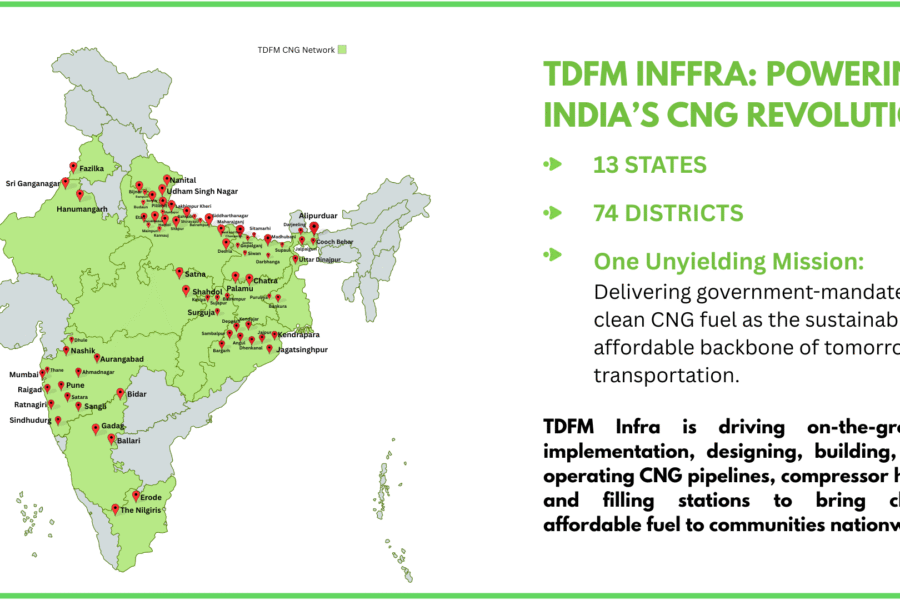
150+ CNG stations executed across 19 states
-
21,000+ PNG households connected with safety-first standards
-
Integrated delivery across CNG stations, city gas distribution, and MEP
-
ESG-aligned design for leak detection, low-emission materials, and site safety
TDFM builds today’s CNG backbone while preparing for tomorrow’s hydrogen and EV-ready infra.
Frequently asked questions
Is CNG a stop-gap or a long-term solution?
Both. It cuts emissions and operating costs now and complements EVs as charging scales.
Does CNG really reduce emissions vs petrol and diesel?
Yes, independent studies show lower CO₂ and NOx relative to petrol and diesel, provided vehicles are maintained to standards. ScienceDirectFIA Foundation
Will CNG stations keep growing after 2025?
Yes. PNGRB MIS and policy targets indicate ongoing expansion of CNG outlets and PNG connections, including Tier-2 and Tier-3 cities.
TDFM Inffra partners with city authorities, CGD entities and fleet operators to expand clean mobility quickly and safely.
Talk to our team to plan your next CNG corridor or city-wide PNG rollout.